
Quick Answer: Yes. Nearly every roof replacement in Orlando, FL needs a building permit from the City of Orlando or Orange County, depending on your address. Your licensed roofer usually applies; fees often run about $150 to $800, and the new roof must pass inspection.
Do I need a permit for roof replacement in Orlando, FL? Almost always, yes. This guide explains who issues the permit, what it costs, and how 2026 rules affect your roof and your home sale.
Key Takeaways
- Nearly every Orlando roof replacement needs a permit, whatever the material
- Your address decides the issuing office: City of Orlando, Orange County, or another city
- Orange County roofing permit cost varies, so ask for the fee in writing
- The Florida 25 percent roof rule now depends on your roof’s age and permit history
- The 9th Edition of the Florida Building Code is scheduled for December 31, 2026
- A roof inspection before selling your home in Orlando can protect the deal
Roof Replacement Permit in Orlando at a Glance
| Permit required? | Yes, for nearly every roof replacement |
| Who applies? | Your licensed roofing contractor |
| Who issues it? | City of Orlando, Orange County, or your city’s building office |
| Typical fee | About $150 to $800, depending on the office and project value |
| Inspections | Roof-in-progress (dry-in) and final |
| Notice of Commencement | Required in Orange County on jobs over $5,000 |
| Code in force | Florida Building Code, 8th Edition. The 9th Edition is scheduled for December 31, 2026. |
Which Roofs Need a Permit in Orlando?
The City of Orlando says you must apply for a building permit to replace the roof on an existing home. Orange County requires a roofing permit as well. Florida law and the Florida Building Code drive both rules.
The roof replacement permit applies to every common material:
- Asphalt shingles, the most common choice in Central Florida
- Metal roofing, such as standing seam panels or metal shingles
- Concrete or clay tile
- Flat or low-slope systems, such as TPO or modified bitumen
Recovering an old roof with a new layer usually needs a roofing permit too. It is not a loophole. Commercial re-roofs, including commercial flat roof replacement, need one as well.
Why so strict? Central Florida roofs face hurricanes, heavy rain, and strong summer storms. A permit means an inspector checks the deck, underlayment, flashing, and fasteners before they are hidden.
Who Issues Your Roofing Permit in Orlando?
An Orlando mailing address does not always mean you live inside the City of Orlando. Many homes sit in unincorporated Orange County or a nearby city. Each has its own building office and its own roofing permit process.

City of Orlando
Homes inside city limits get their permit from the City of Orlando. The city publishes a page with instructions for a residential roof permit.
Unincorporated Orange County
Homes outside city limits use Orange County’s Building Safety Division. The county accepts roof permit applications online through its Fast Track system.
Other Cities Near Orlando
Cities such as Ocoee, Winter Garden, and Apopka run their own building departments. Forms, fees, and contractor registration steps can differ. Ocoee, for example, publishes its own residential roofing fee and online portal.
Not sure which office covers your address? Your Orlando roofing contractor can confirm it before you sign a contract. Big Sky Roofing also serves nearby communities such as Windermere.
What Work Needs a Roof Permit?
In general, plan on a permit for any of these:
- A full roof replacement, also called a tear-off
- A roof recovery, where a new layer goes over the old one
- Large repairs, especially after storm damage
- Structural changes, such as new rafters, trusses, or rooflines
- A change in roofing material, such as shingle to metal
Small repairs, like replacing a few shingles, may be treated differently. Some offices require permits for repairs too. Ask the building office before you assume you are exempt.
Your homeowners association may also need to approve your color and material. That approval is separate from the city or county permit.
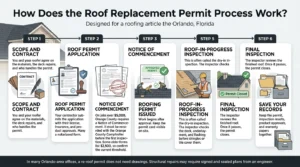
How Does the Roof Replacement Permit Process Work?
The process is simple when a licensed roofer handles it. Here is what usually happens.
- Scope and contract. You and your roofer agree on the materials, the deck repairs, and who handles the permit.
- Roof permit application. Your contractor submits the application with their license, insurance, and product approvals. Many offices need a notarized form.
- Notice of Commencement. On jobs over $5,000, Orange County requires a Notice of Commencement. It must be recorded with the Orange County Comptroller before the first inspection. Some older forms list $2,500, so confirm the current threshold.
- Roofing permit issued. Work begins after approval. Keep the permit card visible on site.
- Roof-in-progress inspection. This is often called the dry-in inspection. The inspector checks the deck, underlayment, and flashing before shingles or tile cover them.
- Final inspection. The inspector reviews the finished roof. Once it passes, the permit closes.
- Save your records. Keep the permit, inspection results, product approvals, and warranty papers together.
In many Orlando-area offices, a re-roof permit does not need drawings. Structural repairs may require signed and sealed plans from an engineer.
How Much Does an Orange County Roofing Permit Cost?
Roofing permit fees are a small part of a roof project. They still vary, so here is a realistic picture.
Typical Permit Fees
- Local 2026 guides commonly put a single-family re-roof permit between about $150 and $800 in the Orlando area.
- Some cities list lower base fees. Ocoee, for example, lists $50 for residential roofing plus state surcharges.
- Many offices base the fee on the project’s value, so a larger or premium roof costs more to permit.
Published numbers do not agree, and fees change. Ask for the exact roofing permit fee on your written quote.
Extra Charges to Ask About
- Notice of Commencement recording: usually a small fee
- Re-inspection fee: often around $75 to $150 if an inspection fails
- Engineering fees: several hundred dollars if structural work needs sealed drawings
- Private provider inspections: optional under Florida Statute 553.791, and they may speed up scheduling
What Drives the Total Roof Cost
Many 2026 Orlando cost guides put shingle roof replacements near $9,000 to $14,000. Metal and tile often run well above $20,000. The permit is a small slice of that.
These factors move the price more:
- Roof size and pitch, as shown in this 1,000-square-foot roof estimate
- Material choice: architectural shingles cost less than metal or tile
- Decking condition, since rotted plywood must be replaced
- Tear-off and disposal
- Complex features such as valleys, skylights, and chimneys
- Warranty level and underlayment upgrades
A fair quote shows the roofing permit as a line item. If it is missing, ask why. For more pricing detail, read our roof replacement near me guide and our guide to the average cost of roof replacement in Florida.
What Is the Florida 25 Percent Roof Rule in 2026?
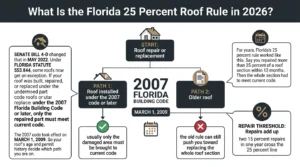
For years, Florida’s 25 percent rule worked like this. Say you repaired more than 25 percent of a roof section within 12 months. Then the whole section had to meet current code.
Senate Bill 4-D changed that in May 2022. Under Florida Statute 553.844, some roofs now get an exception. If your roof was built, repaired, or replaced under the 2007 Florida Building Code or later, only the repaired part must meet current code. The 2007 code took effect on March 1, 2009. So your roof’s age and permit history decide which path you are on.
- Roof installed under the 2007 code or later: usually only the damaged area must be brought to current code
- Older roof: the old rule can still push you toward replacing the whole roof section
- Repairs add up: two 15 percent repairs in one year cross the 25 percent line
Your permit record is your proof. That is one more reason to permit every roof job. Code proposals for the 9th Edition would relax the rule further. Treat that as unfinished until the final code text is adopted.
Your insurer and the building code are separate. An adjuster may scope a smaller repair than the code requires. Ask your roofer to explain both numbers.
How Will the 2026 Florida Building Code Change Affect My Roof?
Florida updates its building code every three years. The 8th Edition is in force today. The 9th Edition is scheduled to take effect on December 31, 2026.
Permit timing matters. Projects permitted before that date generally follow the 8th Edition. Projects permitted after it must follow the 9th. The new edition brings updated wind-load standards and changes to reroofing rules. It can also affect which product approvals your roofer uses. Ask which edition your permit falls under.
Product Approval and Wind Requirements
Every roofing product used in Florida needs a Florida Product Approval number. Your permit paperwork lists the products you plan to use. Inspectors may ask to see the approval information on the job site.
Installation matters as much as the material. Inspectors look at nail patterns, underlayment type, flashing at vents and chimneys, and drip edge along the eaves and rakes.
What Happens If You Skip the Roof Permit?
Skipping the roof permit can look like a shortcut. It usually costs more later. Risks include:
- Fines and stop-work orders if the building office finds the job
- Insurance trouble, since an insurer may question a roof with no inspection record
- Problems when you sell, because buyers, lenders, and title companies check permit history
- Extra cost to open or correct the work so it can be inspected
- Warranty issues, since some manufacturers may not honor a warranty on unpermitted work
If a contractor offers to skip the permit, treat that as a red flag. Walk away.
Do You Need a Roof Inspection Before Selling Your Home in Orlando?
A roof inspection before selling your home in Orlando is a smart, low-cost step. Buyers need homeowners insurance to get a mortgage. Insurers look hard at roof age and condition.
Florida’s 15-Year Roof Rule
Florida law limits how insurers can treat roof age. An insurer generally cannot refuse to issue or renew a policy just because a roof is under 15 years old.
If the roof is 15 or older, the homeowner can get an inspection. If it shows at least five years of useful life, the insurer generally cannot refuse coverage on age alone. That does not mean every insurer will write every policy. It does mean a clean inspection report can save a deal.
Which Inspection Do You Need?
- Standard roof inspection: checks condition, leaks, and remaining life
- 4-point inspection: covers the roof, electrical, plumbing, and HVAC for insurers
- Wind mitigation inspection: documents roof features that can lower premiums
Orlando-area roof inspections commonly cost about $150 to $400, depending on the type and roof size. Big Sky Roofing offers free residential roof inspections.
Check Your Permit History First
Before listing, look up your roof permit history. An open or missing roof permit can stall a sale. If your last roof was never finalized, your roofer can help you close it out.
Repair, Replace, or Offer a Credit?
Once you know the roof’s condition, you have three options. Repair small problems, replace the roof if it is near the end of its life, or offer the buyer a credit. A new roof with a passed final inspection gives buyers and insurers paperwork they trust.
Owner-Builder or Licensed Roofer: Who Should Pull the Roof Permit?
Florida allows owner-builders in some cases. Orange County requires an owner-builder disclosure statement. The exemption also has limits, including rules about selling or leasing the property soon after the work.
For most homeowners, hiring a licensed roofing contractor in Orlando is the safer path. A licensed contractor knows the code, schedules the inspections, and carries insurance. You can verify any Florida contractor’s license at myfloridalicense.com.
Official Sources to Check
Rules and fees change. This guide is general information, not legal or insurance advice. Confirm details with these official sources before you plan your project:
- City of Orlando, Apply for a Residential Roof Permit
- Orange County, Roof Permit
- Florida Statute 553.844, Windstorm loss mitigation; requirements for roofs and opening protection
- Florida Statute 553.791, Alternative plan review and inspection
- Florida Department of Business and Professional Regulation license lookup: myfloridalicense.com
Why Choose Big Sky Roofing
Big Sky Roofing proudly serves homeowners throughout Orlando, Winter Garden, Windermere, Ocala, Maitland, Altamonte Springs, Winter Springs, and surrounding Central Florida communities with residential roof repair, replacement, and hurricane preparation services. Our experienced team helps homeowners identify roofing issues early, understand their options, and make informed decisions before storm season arrives.
Homeowners choose Big Sky Roofing because of our:
- 34 years of Central Florida roofing experience
- Florida Roofing Contractor License #CCC1335755
- GAF Certified Roofing Contractor
- A-Rated BBB Contractor
- Angi Certified and HomeAdvisor Top Rated
- Free residential roof inspections throughout our Central Florida service area
- 20-year workmanship warranty on all roof replacements
- 0% financing for 21 months with approved credit through Enhancify
- Licensed in-house roofing team with no subcontractors
Our goal is to help homeowners across Orlando, Winter Garden, Windermere, Ocala, Maitland, Altamonte Springs, Winter Springs, and nearby Central Florida communities protect their homes with reliable roofing solutions, honest recommendations, and quality workmanship before and after hurricane season.
Conclusion: Permit First, Then Roof
So, do you need a permit for roof replacement in Orlando, FL? Yes. Nearly every replacement needs one, and the permit protects your home, your insurance, and your resale value. Remember the key points. Confirm which office covers your address. Ask for the roofing permit fee in writing.
Stay updated on our services and special offers. Connect with us on Facebook, YouTube, Instagram, and Google Business Profile.
Contact Page and speak with our team about available services.
Frequently Asked Questions About Roof Permits in Orlando
1. Do I need a permit for roof replacement in Orlando, FL?
Yes. Nearly every roof replacement in Orlando needs a building permit, whether you install shingles, metal, or tile. The City of Orlando or Orange County issues it, depending on your address. Your licensed roofer normally applies for the permit and schedules the required inspections.
2. Who issues a roofing permit in Orlando?
It depends on your address. Homes inside city limits use the City of Orlando. Homes in unincorporated Orange County use the Orange County Building Safety Division. Nearby cities such as Ocoee and Winter Garden run their own building departments, and your roofer can confirm the correct office.
3. How much does a roofing permit cost in Orange County?
Local 2026 guides commonly list Orlando-area re-roof permits between about $150 and $800. Fees vary by office and often depend on project value. Ocoee lists $50 for residential roofing plus state surcharges. Ask your roofer for the exact fee on your written quote.
4. Does a roof repair need a permit in Orlando?
Sometimes. Large repairs, structural work, and storm repairs usually need a permit. Some offices require permits for smaller repairs too, while others exempt very small jobs. Rules vary by jurisdiction, so call the building office before you assume a repair is exempt.
5. Can I pull the roofing permit myself?
Possibly, as an owner-builder. Orange County requires an owner-builder disclosure statement, and the exemption has limits, including rules about selling or leasing the property soon after the work. Most homeowners are safer hiring a licensed roofer who handles the permit and inspections.